Better regional planning for South Australia

James Atkinson
Senior Associate
01 July 2026
Despite the centrality of ‘the bush’ in our national narrative, Australians have always been city-dwellers. Paradoxically, for a country so vast, we cluster in a small number of relatively large cities. The reasons are well-known: climate, geography, and the limitations of productive agriculture across much of the continent.
This concentration of population in capital cities is typical of all Australian states, but none more so than South Australia.
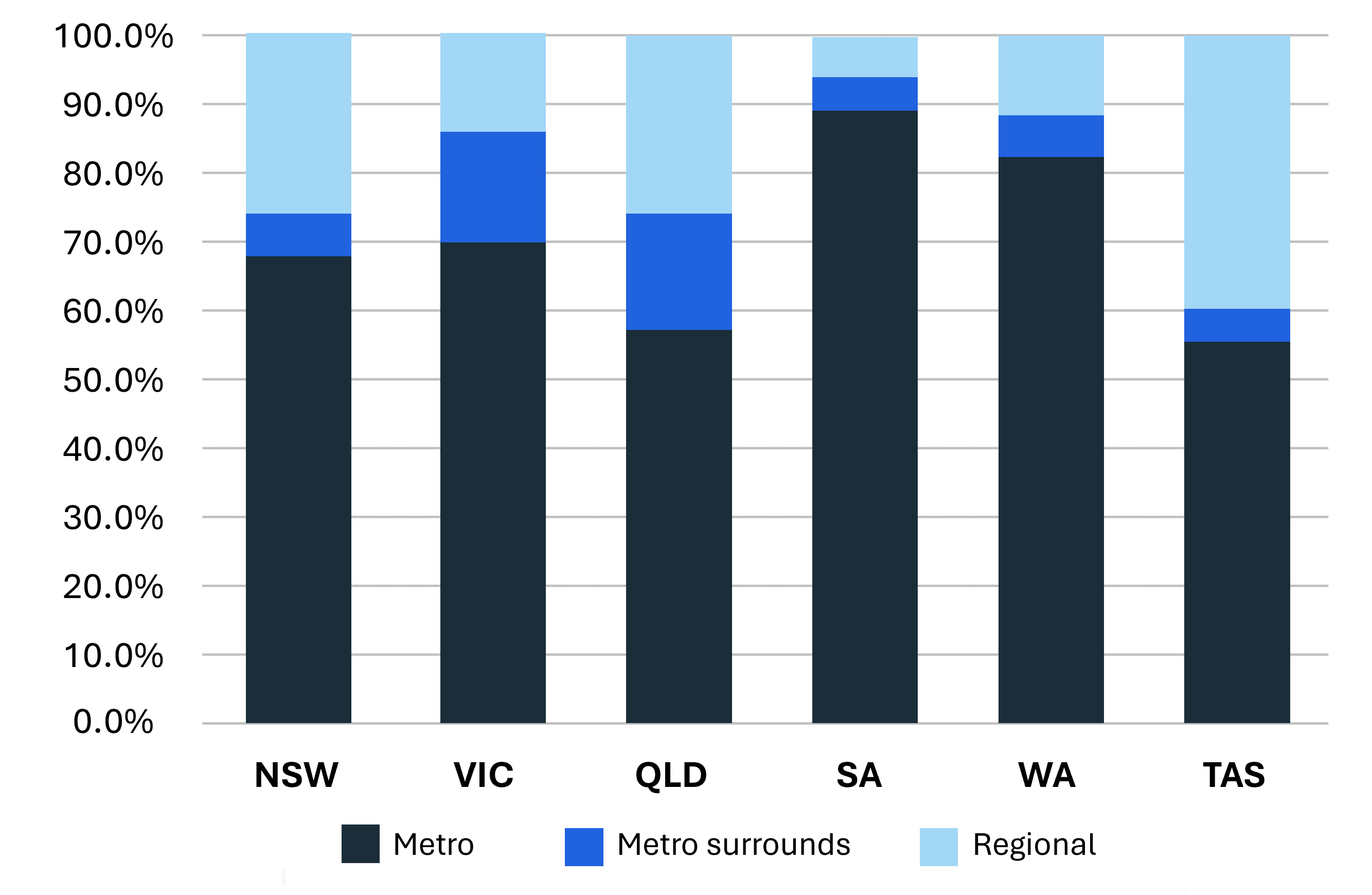
In 2021, the Australian Bureau of Statistics reported that 77.5% of South Australians lived in or adjacent to the metropolitan region – the highest share of any state. Around 290,000 South Australians lived outside the state capital, compared with 2.6 million in New South Wales, 2.0 million in Queensland, and 1.2 million in Victoria. As of 2024, South Australia’s largest regional city, Mount Gambier, barely ranks among the top 50 Australian cities by population.
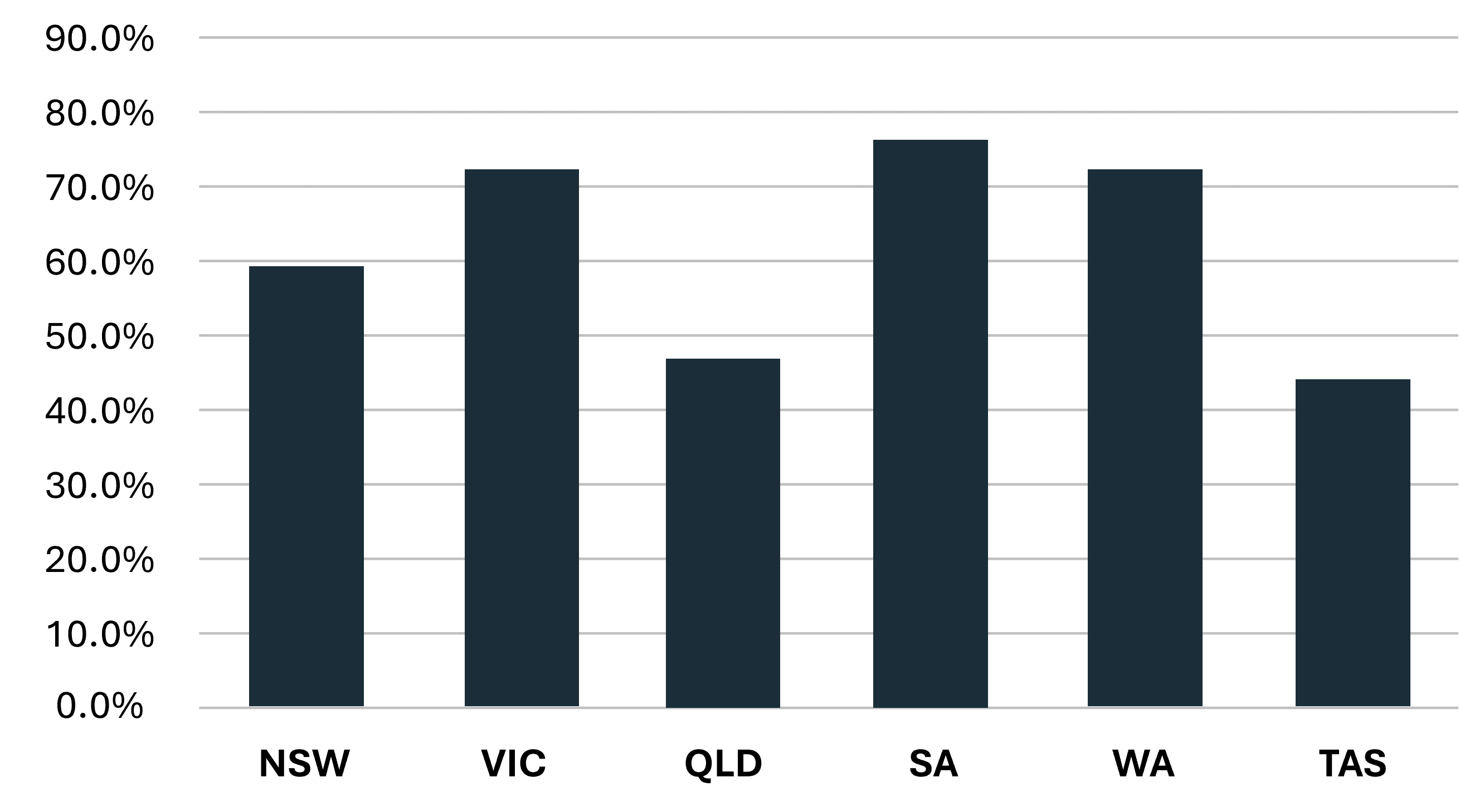
Even as population centralisation accelerates nationally, driven by increasingly capital-intensive primary industries and the pull of agglomeration economies in urban centres, South Australia continues to set the pace. Between 2011 and 2021, 93.4% of South Australia’s total population growth occurred in its capital region – the highest percentage of any state.
So, what’s the issue?
Population centralisation in large cities is a hallmark of modern capitalist economies. It happens wherever people have the freedom to move, driven by economic and social opportunity.
One perspective is that these migration patterns are not a problem that needs a resolution. As individuals naturally gravitate towards better prospects, the decline of regional towns is seen as a regrettable but inevitable by-product of their obsolete roles servicing what were once much larger catchment populations.
Yet general community support for regional development initiatives – including among urban residents – suggests the Australian people reject the idea that market outcomes alone should determine the fate of regional communities.
These defenders of regional development point to clear benefits of regional survival:
- Taking the heat off. Australia’s capital cities are large and growing rapidly by global standards. This puts pressure on city infrastructure, often leading to unsustainable growth.
- Using what we already have. Regional town infrastructure already exists, and is often underutilised, meaning it can accommodate more people without the need for significant public expenditure.
- Protecting what can’t be rebuilt. Our regional towns are part of our individual, family, and national stories. They possess unique and enduring cultures that have value in their own right.
- Preserving genuine choice. A network of thriving regional communities offers real lifestyle alternatives – from young families to retirees.
- Hedging our bets. Spreading economic activity across a wider area reduces exposure to location-specific risks, boosting the diversity of the broader state economy.
South Australia’s regional plans: a positive first step
In recent months, the State Government has released plans to support the growth and development of South Australia’s regions. This is a step in the right direction to counter centralisation and preserve regional communities. The next step is to examine successful strategies from other states and see how they can strengthen the approach.
Borrowing success: a blueprint from other states
Picking winners
Regional development resources are limited. Selecting a defined network of regional centres as the priority for the State’s planning efforts can deliver greater bang for buck. Victoria is an example of a state with a clearly articulated network of regional hubs that form the backbone for regional development.
Under this approach, the best way to secure the future of small and shrinking communities – such as those on the Limestone Coast – is to support growth in larger nearby regional centres, such as Mount Gambier and Naracoorte.
By strategically focusing on fewer places, government can direct investment in transport, education, sports and health infrastructure more effectively. This, in turn, increases the likelihood of attracting private sector operators, including those involved in service delivery, retail and hospitality.
Strength in numbers
Another way to strengthen regional planning is to recognise functional integration between neighbouring towns. Clusters of townships often operate as a single economic region, even if they remain administratively separate. Residents travel between them for work, education, retail and services, and businesses operate across township boundaries.
The Riverland towns of Renmark, Berri and Loxton exemplify this pattern. Although located across three LGAs, they exist within a shared regional economy and, together, have a combined population exceeding 30,000. Recognising this integration in state planning would give the region greater visibility and scale, supporting more diverse retail and service businesses and enhancing liveability. It would also strengthen the region’s ability to attract both public and private investment.
Victoria offers a comparable model. Moe, Morwell and Traralgon, while non-contiguous townships, are treated as a single regional city – Latrobe – which sits alongside Ballarat and Bendigo in the State’s regional city hierarchy.
Blurring boundaries
Council amalgamation is a recurring issue in regional planning across Australia. Supporters of smaller councils argue that decisions about planning and local services are best made at the community level. Proponents of amalgamation contend that larger councils are better resourced and better placed to coordinate regional planning.
In South Australia, many councils have a limited rates base and are largely confined to basic service provision. Strategic planning capacity is limited, and when planning does occur, it often fails to account for what is happening across neighbouring LGA boundaries.
The establishment of Latrobe City in Victoria in 1994 provides one example of reform. By bringing together multiple townships under a single council, it enabled coordinated strategic and spatial planning, reduced duplication, and strengthened the region’s ability to compete for public and private investment.
Similarly, council mergers in New South Wales in 2016 supported more integrated regional planning by recognising the interrelationships between cities and their hinterlands. Larger councils also benefited from stronger funding bases and more coordinated planning.
Sharpening focus
South Australia has a Minister for Regional Development. That tells us something important: the Government cares about the future of our regions.
But regional South Australia is vast and diverse. One minister, covering the entire state outside Adelaide, carries an enormous brief. The risk is not lack of intent, but lack of focus.
New South Wales has taken a different approach, assigning ministerial responsibility to specific parts of regional NSW, including the North Coast, Central Coast, Hunter, and Illawarra and South Coast. That model keeps regional priorities firmly on the agenda and strengthens accountability for results.
South Australia’s fork in the road
Urban concentration is accelerating across Australia, and South Australia is setting the pace. No other state has seen such a large share of population growth in its capital. In this sense, South Australia is winning a race it may not want to run – one that concentrates pressure in Adelaide while leaving regional infrastructure underused and regional communities diminished.
The State Government’s regional plans are a welcome step, acknowledging this trajectory, the strong public support for regional development, and the benefits that thriving regions provide. With that momentum, now is the time to learn from the place-based strategies adopted in other states and to tailor those approaches to South Australia’s regional networks and economic strengths.
As centralisation continues across Australia, the question for South Australia remains: will it take bold action to defy the trend and control its future?
James Atkinson is a Senior Associate in TSA Riley’s Adelaide team, specialising in economic evaluation, land use forecasting, economic development, strategic land use planning, and infrastructure business cases.
To discuss regional planning, economic development, or infrastructure investment with James, please reach out.