Northern Hub Constructability Review
Network Rail
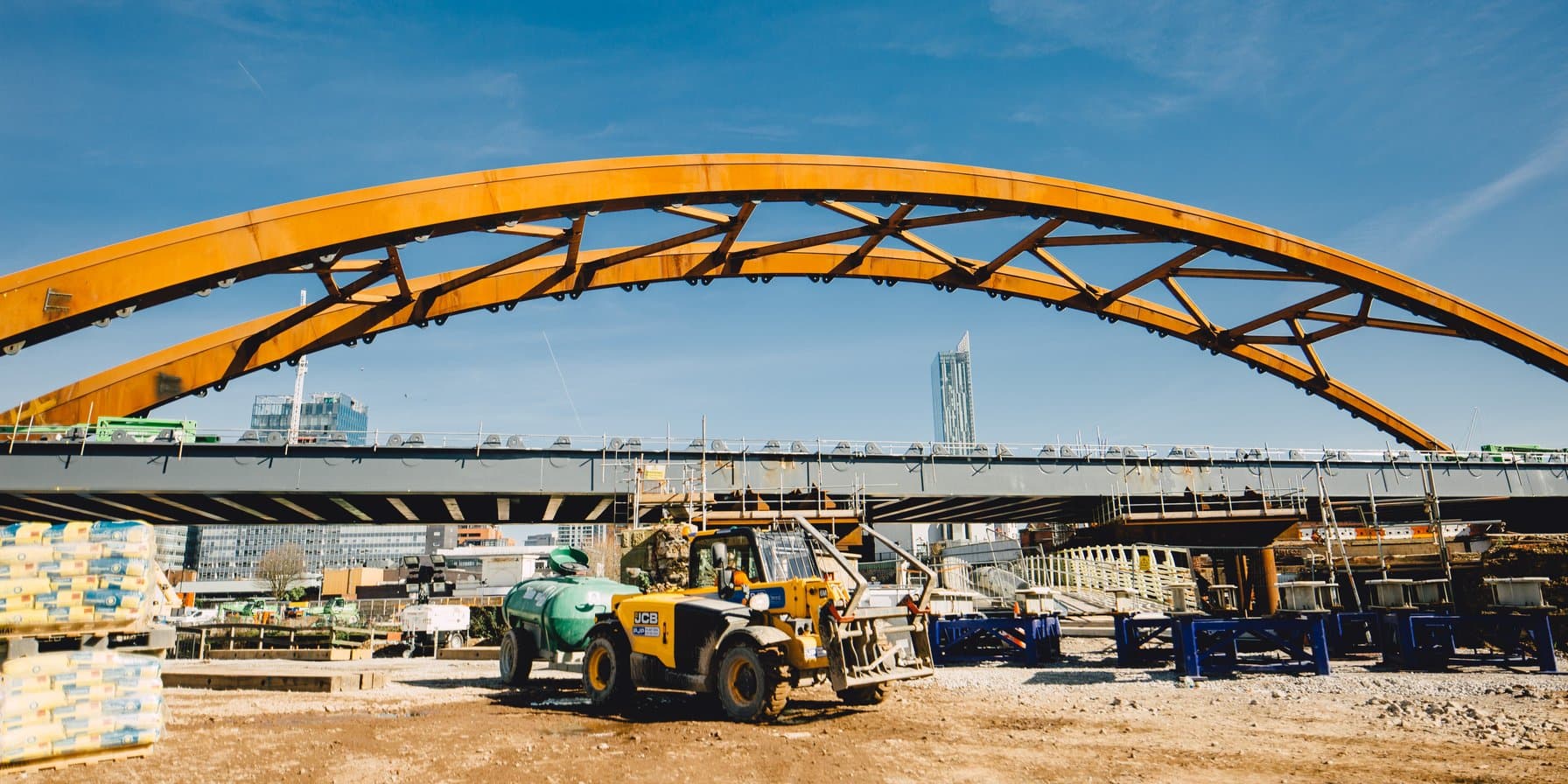
Our team produced a detailed constructability review that was used to support the Environmental and Consents teams in preparation of the Transport Works Act Order (TWAO) application and Environmental Impact Assessment (EIA).
The congested city centre construction site for the Northern Hub project, a new railway bridge known as the Ordsall Chord, was faced with adjacent highways, waterway, land, property owners and Grade 1 and 2 listed buildings caused some key challenges to the £350m project.
Significant constraints to planning consents, construction logistics and temporary land requirements.
The connections of the new chord and adjacent major railway junction required the longest railway closure in history to the busiest section of railway in the Northwest, causing complex multidisciplinary staging requirements.
This railway closure had to be integrated with road closures on the Manchester inner ring road, requiring intensive and sensitive stakeholder negotiation of options.
Our team produced a detailed constructability review that was used to support the Environmental and Consents teams in preparation of the Transport Works Act Order (TWAO) application and Environmental Impact Assessment (EIA).
Based on review outputs, working together with designers, our team developed the detailed design and construction schedule, including integration milestones and dependencies with 3rd party consents, which considered:
- Discipline staging, including enabling works and strategy for compounds.
- Material deliveries, vehicle volumes, logistics and access routes.
- Traffic management and road closures requirements based on site surveys and traffic management analysis.
- Redline boundary identification for temporary and permanent land acquisition based on design and construction requirements.
- Construction risks and mitigations.
The quality of our team's early considerations for potential risks during construction provided a risk-based approach to the construction plan and ultimately led to TWAO award without arduous planning conditions to further constrain the construction strategy.
Our constructability review was also utilised by Network Rail to inform procurement of an Alliance contract, made of 4 tier contractors and Network Rail as Owner Participant, to design and construct the new bridge structure. Our team were subsequently selected to play a key role in managing the construction plan through to commissioning of the new bridge.
This schedule became the performance baseline for the project, enabling communication and interface with key stakeholders throughout design and construction, with delivery to time and cost.
Our experience on this complex construction has provided the team with key win themes that we have gone on to implement as principles to all projects:
- Early engagement and clear communication with 3rd party stakeholders enabled construction risks to be mitigated during the planning phase, with favourable outcomes for construction methodology embedded into planning approval.
- Early identification of the project's staging enabled efficiency of supply chain integration.
- Early understanding of the construction strategy positively influenced the design process by ensuring that staged design requirements were understood, and designs were developed to mitigate construction staging constraints.