Independent Delivery Assurance for Australian Energy Infrastructure Projects

Johanna Maslem
Principal | National Delivery Assurance Capability Lead | AU
03 November 2026

As Australia's energy transition from coal to renewables accelerates, success will depend not only on building new assets, but on ensuring those assets are delivered with confidence. Robust, independent Delivery Assurance provides project sponsors with the visibility, challenge, and insight needed to navigate increasingly complex infrastructure environments.
But first: what is Delivery Assurance?
‘Delivery Assurance’, also known as Programme Assurance, Gateway Assurance or Delivery Confidence Assessment, provides independent challenge, insight and verification across the project lifecycle, giving clients confidence that an asset is deliverable, risks are understood and managed, and intended outcomes can be achieved.
“Delivery Assurance is not about finding fault. It's about providing independent insight that enables better decisions.”—Johanna Maslem, Australian Delivery Assurance Lead, TSA Riley
By identifying risks, testing assumptions and challenging optimism bias early, assurance helps project owners, boards and investors make confident decisions and improve the likelihood of successful project outcomes.
It sits somewhere between traditional project management and a formal audit. And the first word in Delivery Assurance is independence.
Read more about Delivery Assurance.
How is assurance different to project delivery?
Project Delivery focuses on successfully planning and executing a project to achieve its objectives, while Project Assurance provides independent oversight and challenge to ensure the project remains aligned with its business case, governance requirements, risks and expected outcomes.
Delivery
- Executes the work
- Responsible for outcomes
- Manages risk
- Makes delivery decisions
Assurance
- Evaluates readiness and performance
- Provides independent challenge
- Assesses whether risks are being managed effectively
- Informs better decisions
Australia's energy transition is creating unprecedented delivery challenges
Australia is entering one of the largest energy infrastructure investment cycles in its history. Federal and State Government decarbonisation targets, the retirement of aging coal-fired power stations, growing electricity demand from data centres and industrial electrification, and increased renewable energy penetration are driving unprecedented capital investment across the country. Infrastructure Australia and the Australian Energy Market Operator continue to identify transmission, generation, storage and enabling infrastructure as critical national priorities.
With around 90% of the existing coal fleet expected to retire by 2035, (Australian Energy Market Operator) the challenge is not simply replacing generation capacity. It is ensuring new, reliable and resilient energy sources are in place before those assets leave the grid.
Behind this transition sits a fundamental redesign of Australia's energy system, spanning:
- renewable generation
- transmission networks
- energy storage
- grid modernisation.
Time is the first delivery challenge. Close behind are the competing demands of energy security, programme complexity, evolving investment models, resource availability, social license, and the sheer scale of delivering infrastructure across a vast country where many projects are in remote regions.
As with any mission-critical infrastructure programme, much of this work must be delivered simultaneously, despite mounting labour shortages, availability of investment, supply chain constraints and regulatory pressures.
Australia does, however, have a significant advantage. Our abundant solar and wind resources, combined with national decarbonisation, electrification and net-zero commitments, provide a compelling foundation for the transition and an opportunity to reshape the country's long-term economic future.
Energy infrastructure projects are hugely exposed to delivery risk
It feels like there’s a new headline every day: community concerns, planning delays, investment uncertainty, and technological change – before the project has even been implemented.
For asset owners, this means navigating ever-changing complexity to deliver on time and within budget, in scope, and with stakeholders on side.
The result? Risk.
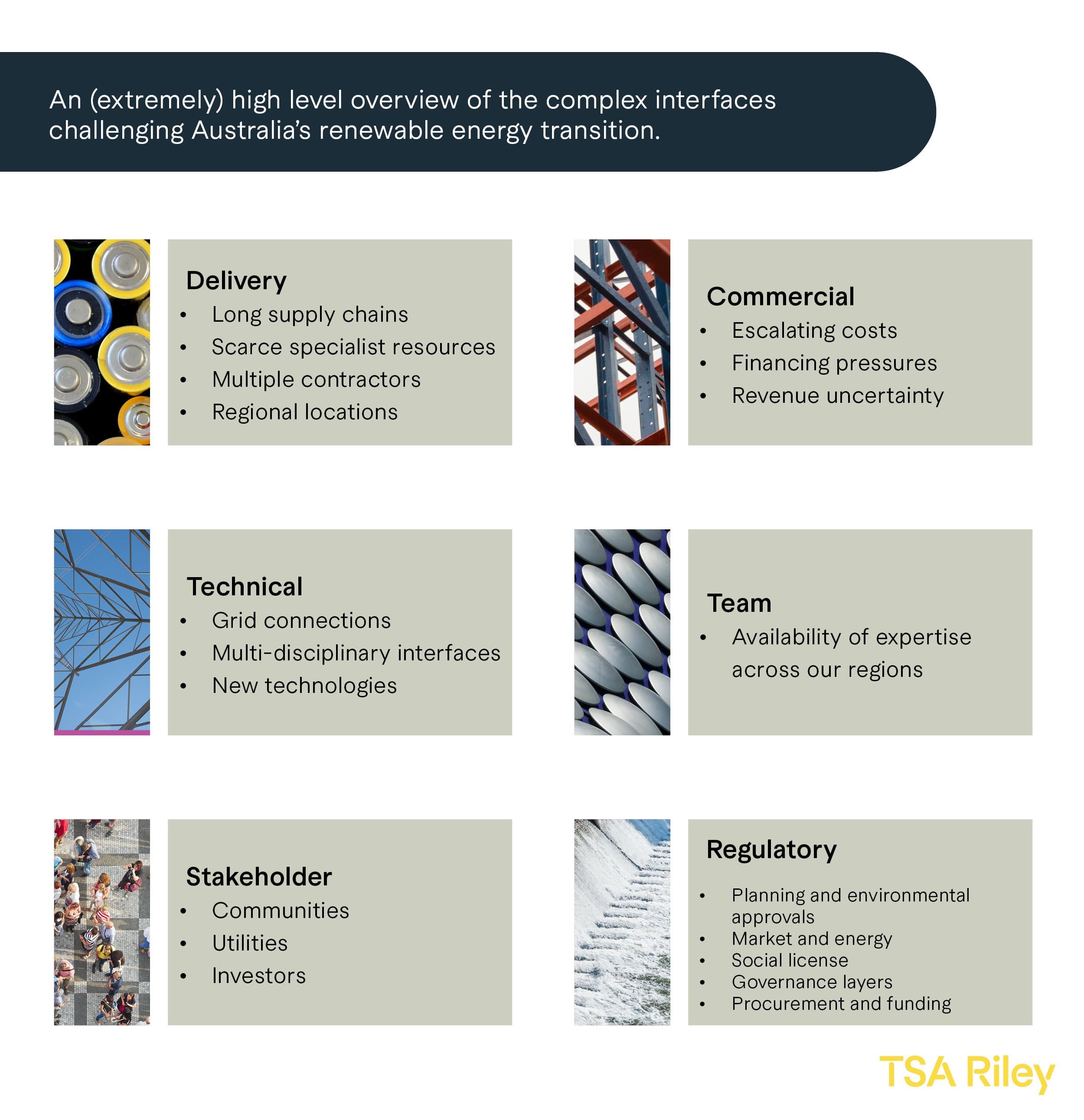
In each of these areas, the complexity is evolving all the time. The technology approved today might be obsolete tomorrow. There could be a change of government, leading to a change of policy. Geopolitical influences could impact supply chains – blowing out costs and delivery time. Investors could get cold feet. Contractors might dispute a changing scope… the list goes on.
And this is where Delivery Assurance steps in.
Where Delivery Assurance creates value across the energy project lifecycle
From project inception – and ideally before – through to delivery and optimisation, Delivery Assurance can test, assess and identify where the project might stall, where the assumptions are off, and where there is a gap between optimism and what the team can realistically deliver.
In the energy space, Delivery Assurance often focuses on Independent Certification and Independence Assurance – including:
Strategy and planning
- Investment decisions
- Business cases
- Governance frameworks
Development and approvals
- Risk identification
- Procurement readiness
- Delivery strategy
Commissioning and operations readiness
- Readiness reviews
- Operational transition
- Benefits realisation
Design and procurement
- Scope certainty
- Interface management
- Cost and schedule controls
Construction
- Performance monitoring
- Predictive risk management
- Independent oversight and reporting
“Delivery Assurance turns complex project ambitions into predictable energy realities. TSA Riley's team can help challenge assumptions, close the gap between optimism and execution, and de-risk your investment across every phase of the project lifecycle.”—Jason Clegg, National Energy Lead, TSA Riley.
What do successful Independent Assurance teams have in common?
A project-wide perspective
This enables Independent Assessors to understand emerging risks, advance warnings, delay events and commercial trends before they develop into significant disputes.
The right experience
Deep experience in similar sectors means the Delivery Assurance team will understand the technical, commercial and stakeholder challenges unique to each project environment.
They’re part of the team
Independent Assessors must be capable of integrating seamlessly into multidisciplinary client-side teams (while maintaining independence, impartiality and procedural fairness) to ensure they are up to date as the project evolves.
The ability to connect the dots
Collaboration, coordination and clear accountability are essential for Delivery Assurance specialists to manage the complexity of large-scale projects and ensure they always have the full story.
Processes that promote clarity
Early clarification of issues and transparent communication can reduce the likelihood of formal dispute escalation.
Surge capacity
When demand for Delivery Assurance services increases during peak project activity, the right support bench of experts who can temporarily join the project team, with minimal down time, is critical to maintain effective and continuous project support.
What does effective Delivery Assurance look like?
The framework of effective Delivery Assurance rests on 5 pillars.
- Independent
Delivery assurance teams must be able to demonstrate that they operate without delivery bias.
This is why Delivery Assurance activity is often undertaken by an independent consultant, without concurrent responsibilities for delivery. - Proportionate
Appropriate to the scale and type of project risk.
Delivery assurance is a specialised discipline; the value-add is when there is complex or significant delivery risk or operational readiness concerns. - Transparent
Each finding or recommendation must be auditable, evidence-based, and answering a clear, pre-determined scope.
Governance pathways must be documented and communicated too. Essentially, transparency means stakeholders understand how and why a conclusion was reached. - Action-oriented
Good Delivery Assurance experts will provide informed, evidence-based decisions and recommend tangible actions, rather than a report alone.
Delivery Assurance is about being solution-focussed and action-biased – it’s not about finding fault. - Continuous
Often conflated to just gateway reviews, Delivery Assurance will add the most value when it sits across the whole project lifecycle – and for mission-critical infrastructure – beyond delivery and into optimisation.
Continuous Delivery Assurance activity means that complex interdependencies are understood and considered.
Delivering the infrastructure required for Australia's energy transition has never been more challenging. Projects face increasing technical complexity, extensive stakeholder engagement requirements, evolving regulatory frameworks and intense competition for capital, resources and skilled labour.
In this environment, independent Delivery Assurance is no longer simply a governance requirement. It is a strategic approach that helps asset owners, investors and delivery teams make better decisions, manage uncertainty and improve confidence that critical energy infrastructure will be delivered safely, efficiently and as intended.
TSA Riley’s Delivery Assurance team provide independent confidence that projects are deliverable, investable and ready to perform.
We combine hands-on construction and commercial experience with independent oversight. Our team has worked across government, contractor and financier environments, giving us practical insight into how projects are procured, staged and delivered - not just how they are planned.
Our Delivery Assurance services provide structured, risk-based oversight across the full lifecycle - from early constructability advice through to independent certification and operational readiness.
Energy at TSA Riley
TSA Riley is an independent client-side project consultancy for the energy transition, with specialised services and capabilities across:
- Advisory
- Project Management
- Cost Management
- Commercial Management
- Asset Management
- Risk and Assurance
- Stakeholder Engagement
Through these complementary service lines, TSA Riley can support owners, investors, governments, utilities and developers across the entire asset lifecycle, from strategy and business case development through delivery, operations, optimisation and asset renewal.
By combining deep sector expertise, independent advice and integrated project delivery capabilities, TSA Riley helps clients navigate Australia's energy transition and deliver the infrastructure required to meet the nation's long-term energy, reliability and decarbonisation objectives.
Email [email protected] to connect with the TSA Riley team.
Meet the author
Johanna Maslem is TSA Riley’s National Delivery Assurance Lead for Australia. She strengthens project performance by equipping teams with the structure, insight and support needed to deliver complex transport programs with long-term success. With a focus on delivery certainty, Jo embeds practical assurance processes and supports clients to make informed decisions that protect scope, time and operational outcomes. Jo brings 20 years of experience across client and consultancy.
Johanna Maslem
Principal | National Delivery Assurance Capability Lead | AU

Jason Clegg
National Energy Sector Lead | AU